What Does Capacity Mean? Guide
Understanding Syringe Capacity
When shopping for diabetes supplies, one of the most important terms you will encounter is capacity. In the context of medical supplies, capacity refers to the total volume of liquid that a syringe barrel can hold. For individuals managing diabetes, selecting the correct capacity is not just about convenience; it is about ensuring dosing accuracy and ease of use. If you are new to using insulin syringes, the numbers can seem confusing at first. Most syringes are labeled in cubic centimeters (cc) or milliliters (mL), and understanding how these measurements relate to your insulin units is the first step in successful management.
CC vs ML: Is There a Difference?
A common point of confusion is the difference between cc and mL. In medical terms, one cubic centimeter (1cc) is exactly equal to one milliliter (1mL). These terms are used interchangeably by manufacturers and healthcare providers. Whether your syringe is labeled as 0.3cc or 0.3mL, it holds the same amount of liquid. The markings on the side of the syringe, however, are usually scaled in units of insulin. For standard U-100 insulin, 1.0cc of volume holds 100 units of insulin. Understanding this relationship helps you navigate our Insulin Syringes: Buying Guide with confidence.
Common Syringe Capacities
- 0.3cc (0.3mL): Designed for doses of 30 units or less. These syringes often feature half-unit markings for high precision.
- 0.5cc (0.5mL): Designed for doses between 31 and 50 units. This is a versatile middle-ground size.
- 1.0cc (1.0mL): Designed for doses between 51 and 100 units. These are used for larger insulin requirements.
Insulin syringes typically come in three standard capacities to accommodate different dosage ranges. Choosing the one closest to your maximum dose can make the scale easier to read.
Why Choosing the Right Capacity Matters
The primary reason to pay attention to capacity is accuracy. A smaller capacity syringe, such as a 0.3cc model, has a thinner barrel. Because the barrel is thinner, the unit markings on the side are spaced further apart. This makes it much easier to see the lines and draw an exact dose. If you use a 1.0cc syringe for a small 5-unit dose, the markings will be very close together, increasing the risk of a dosing error. For more details on specific sizes, you can read our guide on 0.5cc Insulin Syringes or our dedicated look at 1.0cc Insulin Syringes.
Recommended Syringes by Capacity
Depending on your prescribed dose, different brands offer various benefits for each capacity level.
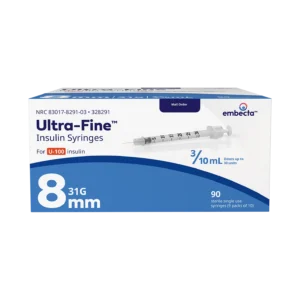
Best for Small Doses (0.3cc): This 0.3cc syringe is ideal for those requiring 30 units or less, offering high visibility for small measurements.
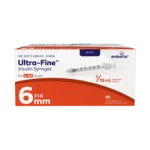
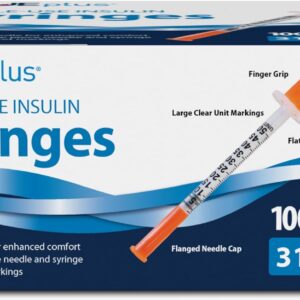
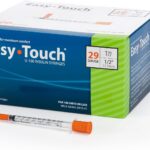
Best for Standard Doses (0.5cc): A cost-effective 0.5cc option that provides a clear scale for doses up to 50 units.
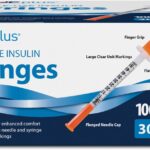
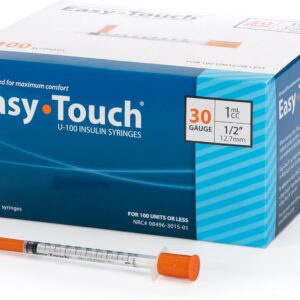
Best for Large Doses (1.0cc): Designed for maximum capacity, this 1.0cc syringe is perfect for those with higher insulin needs.
Frequently Asked Questions
Can I use a larger syringe than I need?
Yes, you can use a larger capacity syringe for a smaller dose, but it may be harder to read the scale accurately. It is generally recommended to use the smallest capacity that fits your entire dose.
Does the needle length change with the capacity?
Not necessarily. You can find different needle lengths, such as 5/16 inch or 1/2 inch, across various capacities like 0.3cc, 0.5cc, and 1.0cc.
What is the most common syringe capacity?
The 0.5cc syringe is very common because it covers a wide range of doses up to 50 units, making it suitable for many patients.
How many units are in a 0.3cc syringe?
A 0.3cc syringe is designed to hold up to 30 units of U-100 insulin.