5/8 vs 1/2 Inch Needles: Comparison Guide
Understanding Needle Length and Injection Depth
Selecting the correct needle length is a critical step in medical administration. The length of a needle determines which layer of tissue the medication reaches, which directly impacts the absorption rate and the overall efficacy of the treatment. Two of the most common lengths found in standard syringes and needles are 1/2 inch and 5/8 inch. While the difference of 1/8 inch may seem negligible, it can be the deciding factor between a subcutaneous injection and a shallow intramuscular one. Proper site preparation with alcohol swabs is always recommended regardless of the needle length chosen.
The 1/2 Inch Needle: Standard for Subcutaneous Use
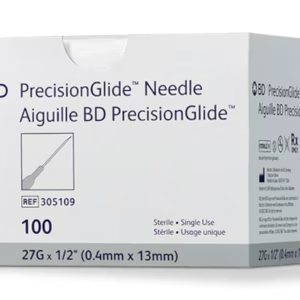
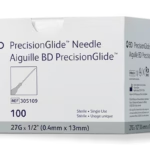
The 1/2 inch needle, which measures approximately 12.7mm, is widely considered the standard for subcutaneous injections. These injections are intended to deliver medication into the fatty tissue layer located just below the skin and above the muscle. Because this layer has few blood vessels, medication is absorbed slowly and steadily. This length is ideal for patients with a lower body mass index or for injection sites where the skin is thinner. Using a needle like the BD PrecisionGlide 27G x 1/2 inch ensures a precise delivery with minimal discomfort.
The 5/8 Inch Needle: Versatility and Depth
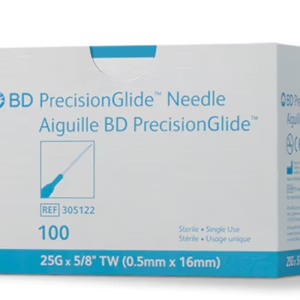
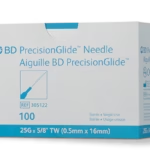
The 5/8 inch needle measures approximately 16mm. This additional length provides more versatility than the 1/2 inch variant. It is frequently used for subcutaneous injections in patients with more adipose tissue to ensure the medication bypasses the dermal layers entirely. Additionally, the 5/8 inch length is often the preferred choice for shallow intramuscular injections, such as certain vaccinations administered in the deltoid muscle of children or thin adults. Products such as the BD PrecisionGlide 25G x 5/8 inch are staple items in clinical settings due to this flexibility.
Key Differences: 5/8 vs 1/2 Inch
- Length in Millimeters: 1/2 inch is 12.7mm; 5/8 inch is approximately 16mm.
- Primary Tissue Target: 1/2 inch is strictly subcutaneous; 5/8 inch can be subcutaneous or shallow intramuscular.
- Patient Body Type: 1/2 inch is better for lean patients; 5/8 inch is better for patients with more subcutaneous fat.
- Common Gauges: 1/2 inch needles often come in higher (thinner) gauges like 27G or 30G; 5/8 inch needles are common in 25G.
- Injection Angle: 1/2 inch needles are often inserted at a 90 degree angle; 5/8 inch needles may require a 45 degree angle for subcutaneous use in thinner patients.
When comparing these two lengths, consider the following technical and clinical differences:
How to Choose the Right Length
The decision between 5/8 and 1/2 inch should be based on the specific medication requirements and the anatomy of the patient. Always consult with a healthcare professional to determine the appropriate size for your needs.
Best for standard subcutaneous use: This thinner gauge and shorter length provide maximum comfort for routine subcutaneous injections.
Best for deeper subcutaneous or shallow IM: The 5/8 inch length offers the necessary depth for patients with more tissue or for specific clinical applications.
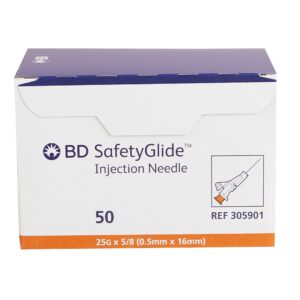
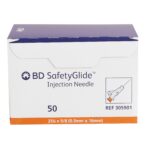
Best for safety and clinical environments: Combines the versatile 5/8 inch length with an integrated safety shield to prevent accidental needle sticks.
Safety and Disposal
Regardless of the needle length you choose, safety is paramount. Never reuse needles, as this increases the risk of infection and tissue damage. After use, immediately place the needle in a puncture resistant container such as the Covidien SharpSafety Sharps Container. For more information on needle types, visit our Standard Syringes and Needles Guide.
Frequently Asked Questions
Is 5/8 inch longer than 1/2 inch?
Yes, a 5/8 inch needle is approximately 3.3mm longer than a 1/2 inch needle. While the difference is small, it allows for deeper penetration into the tissue.
Can I use a 1/2 inch needle for intramuscular injections?
Generally, a 1/2 inch needle is too short for intramuscular injections in adults. A 5/8 inch needle may be used for shallow intramuscular injections in children or very thin adults, but 1 inch to 1.5 inch needles are more common for IM use.
Which length is more painful?
Pain is typically more related to the gauge (thickness) of the needle rather than the length. However, a shorter 1/2 inch needle may feel less intimidating and is often preferred for routine subcutaneous use.
Does the 5/8 inch needle require a different injection technique?
In some cases, yes. If a 5/8 inch needle is used for a subcutaneous injection on a lean patient, a 45 degree angle might be used to avoid hitting the muscle, whereas a 1/2 inch needle is often used at a 90 degree angle.