0.3cc vs 1.0cc: Which Should You Choose?
Understanding Syringe Barrel Sizes
When managing diabetes, the size of your insulin syringe barrel is just as important as the needle gauge or length. The term cc stands for cubic centimeter, which is equivalent to one milliliter (mL). In the world of insulin delivery, 1.0cc is designed to hold up to 100 units of U-100 insulin. Choosing the right size, whether it is a 0.3cc, 0.5cc, or 1.0cc barrel, is primarily about matching the capacity to your specific dose while maximizing measurement accuracy. Using a barrel that is too large for a small dose can make it difficult to see the lines clearly, while a barrel that is too small will not hold the required amount of medication. You can browse our full range of insulin syringes to see the various capacities available.
The 0.3cc Syringe: Precision for Small Doses
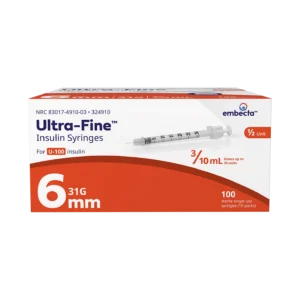
A 0.3cc syringe is often referred to as a 30 unit syringe. It is the smallest standard size available and is specifically engineered for individuals who take small amounts of insulin. Because the barrel is narrower, the lines representing each unit are spaced further apart compared to larger syringes. This increased spacing makes it much easier to draw an exact dose, especially for those with visual impairments or those who require half-unit increments. For the ultimate in precision, products like the BD Embecta Ultra-Fine II Insulin Syringe with 1/2 Unit Markings allow for highly granular dosing that larger barrels simply cannot provide.
The 1.0cc Syringe: Capacity for Large Doses
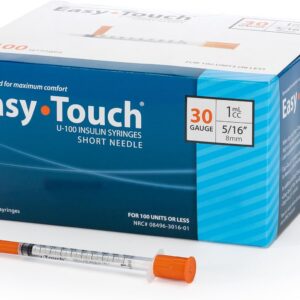
The 1.0cc syringe is the standard high capacity option, capable of holding up to 100 units of insulin. This size is essential for patients who require significant amounts of insulin per injection. While the 1.0cc barrel provides the necessary volume, the unit markings are closer together than they are on a 0.3cc barrel. This means that while it is perfect for large volumes, it may not be the best choice for very small doses where every half-unit counts. For those needing this capacity, the EasyTouch Insulin Syringe 31G x 5/16″, 1.0cc offers a reliable solution with clear markings for up to 100 units.
0.3cc vs 1.0cc: Key Differences at a Glance
- Maximum Capacity: 0.3cc holds 30 units, while 1.0cc holds 100 units.
- Scale Increments: 0.3cc syringes often feature 1 unit or 0.5 unit markings. 1.0cc syringes typically use 2 unit markings.
- Marking Visibility: The lines on a 0.3cc barrel are wider apart, making them easier to read for small doses.
- Barrel Width: 1.0cc barrels are wider to accommodate more fluid, which can feel different in the hand during injection.
- Dose Accuracy: 0.3cc is superior for doses under 30 units, while 1.0cc is necessary for doses over 50 units.
To help you decide which barrel size fits your routine, consider these primary differences:
Which Should You Choose?
The decision between 0.3cc and 1.0cc is usually dictated by your healthcare provider’s prescription, but understanding the benefits of each can help you manage your supplies more effectively.
Best for Small Doses (Under 30 Units): This 0.3cc syringe provides excellent visibility for small doses and is very cost effective for daily use.
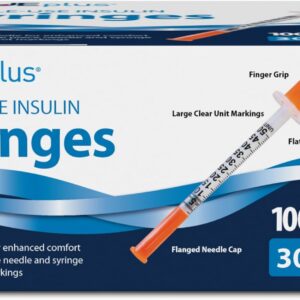
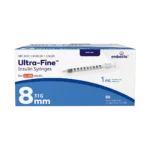
Best for Large Doses (50 to 100 Units): BD is a gold standard in the industry, and this 1.0cc model provides the volume needed for high insulin requirements with a comfortable 31G needle.
Safety and Preparation
Regardless of the syringe size you choose, proper site preparation is vital for preventing infection. Always use a fresh alcohol swab to clean the injection site and the top of the insulin vial. Additionally, ensure you have a dedicated sharps container for safe disposal of used needles. Never reuse syringes, as this can lead to needle dulling and increased risk of lipohypertrophy.
Frequently Asked Questions
Can I use a 1.0cc syringe for a 10 unit dose?
Yes, you can, but it is not ideal. Because the 1.0cc barrel is much wider, the markings for 10 units will be very close to the top, making it harder to measure accurately compared to using a 0.3cc syringe.
What does the cc stand for on an insulin syringe?
CC stands for cubic centimeter. In medical terms, 1cc is the same as 1mL. For insulin, 1cc equals 100 units of U-100 insulin.
Are 0.3cc syringes more expensive than 1.0cc syringes?
Generally, the price is very similar across different barrel sizes of the same brand. The cost is usually determined by the needle technology and the quantity in the box rather than the plastic barrel size.
Do 0.3cc syringes always have half-unit markings?
No, not all 0.3cc syringes have half-unit markings. If you require half-unit precision, you should specifically look for products labeled with ‘half-unit scale’ or ‘1/2 unit markings’.